.avif)
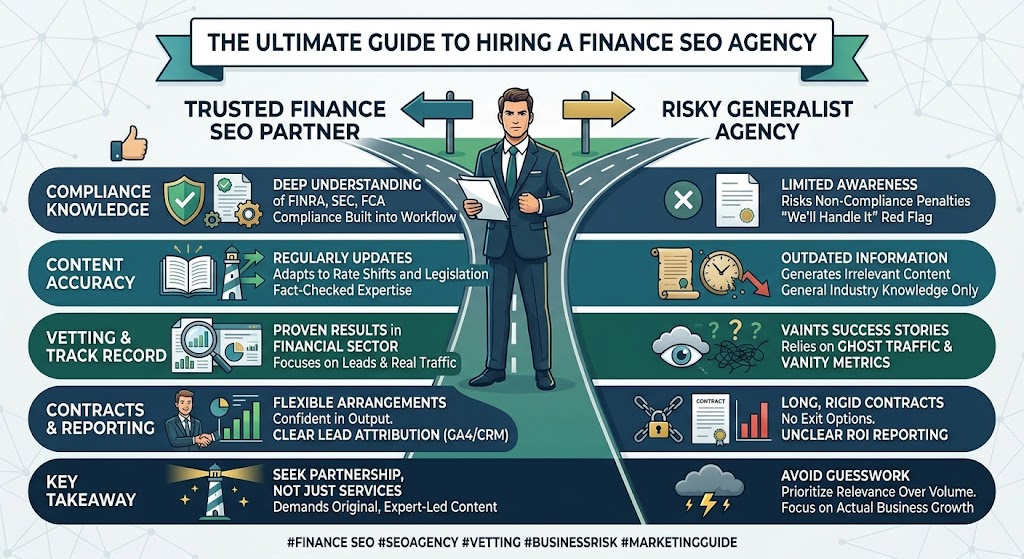

If you run a financial services firm and you're thinking about hiring an SEO agency, this guide was written for you. Not for the agency pitching to you.
After years working in finance SEO, cleaning up the messes left by agencies that overpromised and underdelivered, I've seen every trick in the book. What follows is a straight-talking breakdown of how to vet an agency properly, what questions to ask, and what to walk away from before you've signed anything.
How Do I Know If an SEO Agency Actually Understands Financial Services?
The fastest way to find out is to listen to how they talk about your content workflow.
The "We'll Handle Everything" Red Flag
If their pitch sounds like "tell us what you want to do and we'll take care of the rest", that is your first warning sign. In financial services SEO, that approach is not just lazy. It is genuinely dangerous.
Every piece of content your SEO agency produces falls under your regulatory obligations, whether that is FINRA, the SEC, or the FCA in the UK. Compliance is not something you can hand off to a third party and forget about. Regulators treat the content on your website as your responsibility, full stop, regardless of who wrote it. Every blog post, every service page, every FAQ needs to be reviewed and approved by someone on your team before it goes live.
A finance-specialist agency will tell you this before you even ask. They will build a review and approval process into the workflow as a matter of course. A generalist agency will tell you they can handle everything independently, which should immediately raise the question of whether they understand what they're getting you into.
The Accuracy Problem Nobody Talks About
The second thing a genuine finance SEO specialist will flag is accuracy. Financial data changes. Interest rates move. Regulatory thresholds get updated. Legislation shifts. An agency writing content for a financial firm needs to understand that publishing outdated figures is not just an SEO issue. It is a compliance issue.
If an agency does not raise either of these points before you do, ask yourself honestly: do they actually understand this industry, or are they just rebranding their generic service with a finance label on it?
What Questions Should I Ask Before Hiring an SEO Agency?
Beyond the standard portfolio review, there is one question that immediately separates agencies who genuinely understand financial services from those who are bluffing.
The Compliance Litmus Test
Ask them this: "Do you have a compliance officer, or someone on your team responsible for ensuring your work meets FINRA, SEC, and FCA standards?"
The answer will tell you a lot. It does not have to be a full-time compliance officer. It could be a consultant or a designated team member whose job is to review content against regulatory guidelines before it lands with you. What matters is that this function exists somewhere in their process.
If they look blank, stumble, or tell you that is your team's job, you have your answer. They are not set up to work in your sector.
A Discovery Call Checklist Worth Using
Beyond the compliance question, here are the things worth pressing on:
- How do you handle content that becomes outdated after publication, and who is responsible for flagging it?
- What is your process for ensuring content does not stray into financial advice territory if that falls outside our licence?
- Can you walk me through how your reporting separates estimated traffic from actual sessions and conversion events in GA4?
- What does success look like in months three to six, in terms of leads rather than rankings?
The answers will tell you not just what the agency knows, but how they actually think.
How Do I Find an SEO Agency That Specialises in Finance?
This is harder than it sounds, because every agency claims to specialise in everything. "We work across multiple sectors including finance" is not specialisation. It is hedging.
What a Real Finance SEO Specialist Looks Like
Genuine finance SEO specialists will demonstrate familiarity with the regulatory landscape without being prompted. They will reference FINRA, the FCA, or SEC guidelines naturally in conversation, not as a rehearsed answer to your question. They will understand the difference between informational and commercial intent in a financial context. And they will be able to speak specifically about how they balance content compliance with search performance.
Ask for examples of financial services clients specifically, not just professional services broadly. Ask what compliance process they followed for those clients. And if they reference case studies with impressive traffic numbers, read the next section before you take those figures at face value.
How Do I Evaluate an SEO Agency's Track Record?
This is where most financial firms get burned, and it comes down to understanding one thing clearly.
Estimated Traffic Is Not Real Traffic
Tools like Semrush and Ahrefs give traffic estimates based on keyword rankings. Those estimates are not always reflective of actual sessions, and they tell you nothing about whether those visitors did anything once they arrived. An agency can show you a line going up and to the right on a chart that is entirely disconnected from your real business performance.
I call this ghost traffic. It tends to happen when agencies publish large volumes of low-intent informational content targeting niche long-tail keywords. The software records a ranking and assigns it a traffic value. Your Google Search Console and GA4 tell a very different story.
What We Found When We Cleaned Up Someone Else's Mess
We took on a financial services client in January 2026 whose previous agency had used AI to produce hundreds of blog posts, churning out content at scale with no meaningful editorial process. Semrush showed traffic increases. Ahrefs showed keyword growth. When we looked at their actual Search Console data, traffic had fallen. When we checked their CRM, not one of those posts had generated a single client enquiry.
What had happened was entirely predictable once you understand keyword cannibalisation. By targeting so many niche informational topics with thin content, the agency had quietly diluted the authority of the pages that actually mattered, the commercial and conversion-focused pages that should have been driving leads. They had traded real business value for the appearance of progress.
What to Actually Ask For When Reviewing Case Studies
When evaluating an agency's track record, ask them to show you:
- Search Console data, not just Semrush or Ahrefs screenshots
- Which specific pages drove which leads or conversions
- What happened to lead volume during the campaign, not just traffic volume
If they cannot or will not show you this, be very cautious about what their case studies are actually telling you.
What Are Red Flags When Hiring an SEO Agency?
Red Flag 1: Guaranteed Rankings Within a Set Timeframe
No honest SEO professional will guarantee a first-page ranking by a specific date. The search landscape is competitive, dynamic, and influenced by factors no agency controls, including algorithm updates, competitor behaviour, and domain authority.
The agencies making these guarantees are usually the same ones pushing you into a long contract on the back of those promises.
Red Flag 2: Long, Rigid Contracts With No Flexibility
A set contract with no exit flexibility is a classic defensive move from an agency that knows results take longer than they want to admit. The logic is: we told you results take six months, so you are locked in for six months even if you cannot see any meaningful work being done.
A legitimate agency should be confident enough in their output to work on rolling or shorter-term arrangements. You should be able to see real work happening, not just wait and hope the rankings eventually show up.
Red Flag 3: Vanity Metrics in Reporting
From day one, demand reporting that goes beyond impressions, total keyword count, and estimated traffic. These numbers are easy to generate, easy to present on a slide, and tell you almost nothing about whether the work is actually bringing you clients.
What you should insist on from day one:
- Organic sessions to conversion-focused pages specifically, not just overall site traffic
- Click data from Search Console broken down by page type, distinguishing informational from commercial pages
- Lead attribution through GA4 or your CRM, showing which enquiries came from organic search
- Month-on-month movement on keywords that represent your actual services and your local area
If the agency pushes back on this or tells you it is too early to look at conversion data, push back harder. You are entitled to understand exactly what you are paying for.
Red Flag 4: AI-Generated Content
In financial services, this one deserves its own category entirely.
AI-generated content is not just an SEO problem. It is a regulatory one. FINRA, the SEC, and the FCA all treat content published on your website as content you are responsible for. There is no defence that amounts to "an AI wrote it." The content is on your domain, under your brand, and any consequences around inaccuracy or non-compliance fall squarely on you.
Beyond the compliance issue, there is a deeper strategic problem with AI content in 2026. Google's emphasis on original insights and first-hand experience is stronger than it has ever been. If AI systems are learning from the internet, and the internet is increasingly full of AI-generated content, then AI is essentially learning from itself. Nothing genuinely new gets added. I think of this as cyclical AI learning, and it is exactly why Google is pushing so hard towards original, expert-led content right now.
Agencies using AI to produce content at scale are, in most cases, generating material that briefly captures informational rankings and delivers no commercial value. That is precisely what happened with the client we inherited in January 2026. The content looked good in the tools. It failed completely in the real world. We spent months removing what was causing harm and rebuilding with real input from their team.
Finance SEO: A Case Study in What Goes Wrong (And How to Fix It)
The January 2026 Cleanup
The most telling sign of whether a finance SEO case study is genuine is whether the agency can explain what went wrong as clearly as what went right.
Generic agency portfolios show you the traffic chart going up. Real specialists can tell you: here is where the site was when we arrived, here is what the previous strategy had done to its authority, here are the specific decisions we made, and here is what happened to lead volume as a result.
The client we took on at the start of 2026 came to us after their previous agency had prioritised breadth over relevance. The strategy had been built around covering as many informational queries as possible, using AI to produce the volume. The result was a site with hundreds of pages, almost none of which targeted commercial keywords, and a compliance risk serious enough that we had to treat the content audit as a legal hygiene exercise before we could build anything new.
What the Recovery Actually Looked Like
We worked closely with their internal team to produce content that reflected genuine expertise. That meant drawing on their advisers' knowledge, their specific experience with real client scenarios, and their perspective on their own market. We removed the low-quality content that was either not ranking or ranking for queries with no commercial intent. We rewrote what had traction but no conversion focus. And we restructured the keyword strategy to build from local authority outward, establishing a strong foundation in their immediate market before even thinking about national terms.
The Partnership Principle
The lesson from this is consistent with what we see across every finance SEO engagement we run. The relationship between an agency and a financial firm works when the firm is an active contributor, not a passive client.
If your team can contribute personal insights, case studies, anecdotes, or subject-matter perspective, even occasionally, that is where the content becomes genuinely original. That is where you actually start to stand out from every other firm in your space. The agency brings the framework and the technical expertise. You bring the experience and the substance. That combination is what produces content that ranks, converts, and holds its value.
The One Thing to Remember Before You Sign Anything
Forget traffic. Forget impressions. Forget clicks, rankings, and every buzzword an SEO agency throws at you in a pitch.
The only question that matters is this: how many new clients is this going to bring in, which pages are you pushing, and how specifically are you going to get us there?
A credible agency will answer that in concrete terms. They will tell you which service pages are being optimised for commercial intent, how they plan to build local authority before targeting national terms, and what a realistic lead attribution model looks like in months two and three.
They will also be straight with you about the starting point. If your domain is new to Google, it can take up to three months before you see meaningful ranking movement. That is not failure, it is just how it works. But if you have an established domain and have run SEO before, you should see measurable improvement in traffic to your commercial pages within two to three months. If your campaign has not covered its own cost by then, start asking harder questions.
The best finance SEO partnerships are not the ones where an agency disappears for six months and comes back with a report. They are the ones where both sides show up. Anything short of that is just someone selling you a chart.